'/%3E%3C/svg%3E)
Flexible and family-friendly, a dining bench is a simple solution when you need more seating at a dining table. Unlike an individual dining chair that can only seat a single person, a dining bench is built for a crowd. It also slides fully under the table when not in use, so it’s a terrific option for smaller dining rooms.
The right dining bench comes down to a few decisions: the size of your table, the number of seats you need, and how it pairs with your existing chairs. This guide will cover your options and help you find the perfect seat for whoever shows up to the table hungry.
Shop the look
Vista Bay Dining Table w/ Leaves · Vista Bay Side Chair · Vista Bay Dining Bench · Vista Bay 6-pc. Dining Set
Types of Dining Benches
There are several styles of dining benches, each with their own purpose and benefits. If you often host longer meals, support is key. If you prefer a clean look, opt for a bench that slides under the table. Pick the one that meets your needs and fits your space.
- Backless bench: Provides no back support but tucks neatly under the table when not in use. It’s ideal for smaller spaces, kids, and casual meals.
- Bench with backrest: This bench feels like a chair but doesn’t slide fully under the table. It’s a great choice if you have older guests or for longer meals.
- Storage bench: Provides a drawer, shelf, or lift-top seat to store items like linens and placemats. A natural fit for small homes and benches that will be used not just in the dining room, but in other spaces throughout the home.
- Counter-height bench: Pairs well with counter-height dining tables and kitchen islands. Backless and backrest options are available.
- Upholstered bench: Designed for comfort. Choose easy-to-clean performance fabrics if your household has kids or other messy eaters. Other upholstery options include cotton, polyester, linen, and faux leather.
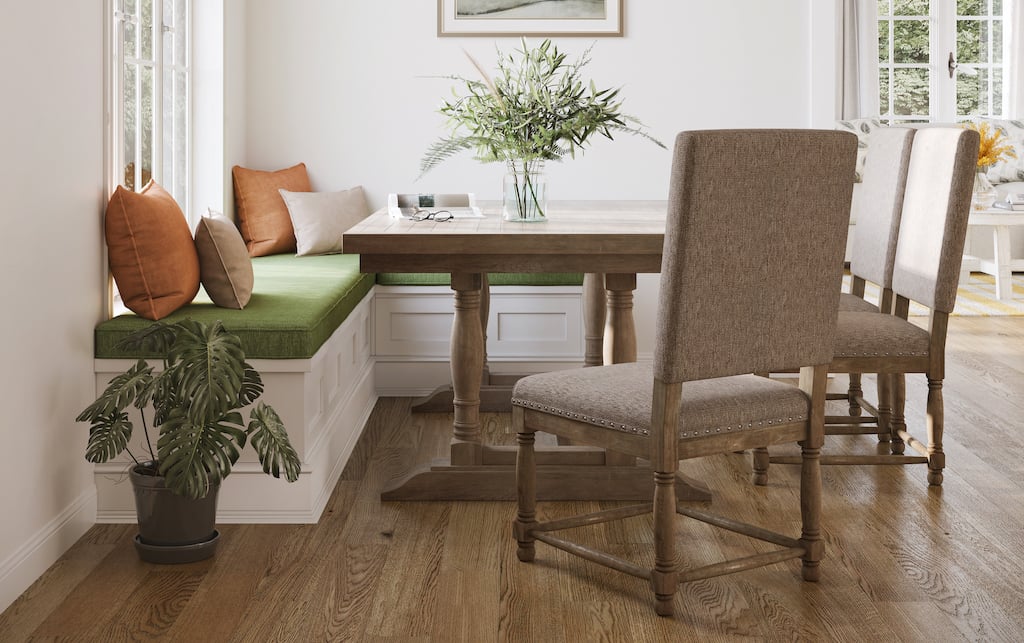
- Corner bench: Pairs well with square or rectangular tables. This L-shaped seat tucks nicely into corners of eat-in kitchens and breakfast nooks.
- Curved bench: Pairs well with round or oval tables. Its curved shape ensures everyone faces the center of the table.
- Settee bench: Typically sits against a wall and has a built-in look.
In terms of materials, most dining benches have a wood or metal frame. The seat can be made of solid wood, which wipes clean easily and delivers long-term durability. An upholstered fabric seat is softer and provides more padding.
Shop the look
Beatrix Counter-Height Table · Beatrix Counter-Height Bench · Beatrix Counter Stool · Beatrix Server · Beatrix 4-pc. Dining Set
How to Choose the Right Dining Bench Size
Start with your dining table’s height and length. From there, you can make sure the dining bench fits between the table legs and leave enough space between the seat and the underside of the table.
Here are the most important measurements to get right before you buy.
Measurement | Recommended Size | Why It Matters |
Bench length | Leave room at each end, ideally 6–12 inches, so it doesn’t bump into a corner or table leg | The bench should tuck cleanly under the table when not being used |
Seat height | Seat should be 10–12 inches below the tabletop | Give knees and thighs enough room under the table |
Seat depth | A depth of 13–16 inches is comfortable for a seat | A narrow bench may not be as comfortable, especially for adults; a deeper bench provides more support for longer meals |
Clearance behind the bench | At least 36 inches should be between the bench and the nearest wall or furniture piece | Leave enough room to pull out the seat and for comfortable walkways |
Other things to keep in mind when choosing a dining bench size:
- Check the table base: On a table with four legs, you are limited to placing the bench between the legs on one side. On a table with a pedestal base, you have a bit more flexibility since the base sits toward the center and the bench can run the full length of the table.
- Check the apron: First, check to see if your table has an apron, which is the frame just under the tabletop. The bench needs to clear the apron and give you enough legroom to sit comfortably.
- Account for cushions and upholstery: A cushion can increase the finished seat height, while a backrest or upholstered edge may affect how far the bench can slide under the table. Use the finished product dimensions when checking the fit.
Dining Bench Seating Capacity: How Many People Fit
A good rule of thumb is that adults need about 22–24 inches per seat. Keep that measurement in mind when you’re sizing a dining bench. You don’t want people crowded or bumping elbows while sitting down for a meal. Kids need less space, which usually frees up one additional seat.
Bench length | Seats for adults | Seats for kids |
42–48 inches | 2 | 2–3 |
60–66 inches | 2–3 | 3–4 |
72 inches | 3 | 4 |
84 inches & up | 3–4 | 4–5 |
Seating capacity is where a dining bench has the advantage. Two chairs on one side of the table can only seat two people, while a bench taking up the same spot can seat up to three adults and maybe even four children. If you host often, this type of flexible seating matters, since you aren’t taking up any extra floor space.
Pro tip: Hosting for the holidays? Place a dining bench on the side of the table where the kids sit. That allows more people to fit at the table and frees up chairs for adults. Additionally, once the meal is over, the bench can easily shift into the living room for overflow seating. Learn more tips in our guide to holiday hosting.
How to Mix a Dining Bench With Chairs
When mixing a dining bench with dining chairs, there are two big factors to weigh: setup and style. The most classic layout is placing a dining bench on a long side of the table, with chairs on the three other sides. With this setup, ideally the bench would be placed on the same side as a wall or window, or where walkways are a bit tighter.
To maximize seating, you can place a bench on the long sides of a rectangular table. This may be a better option for families who host often.
In terms of coordinating a look, you can match finishes for a seamless set, or introduce a contrast, such as an upholstered dining bench to pair with wood chairs. This type of contrast reads as a deliberate design choice.
There are a few other ways to make the pairing look intentional. Try to match the bench seat height with the chair seat heights to ensure everyone is sitting at the same level. If you plan on sliding your dining bench fully under the table when not in use, make sure there’s also enough room for the head chairs to slide in and out without making contact.
Shop the look
Volterra Table Lamp · Harvest Large Pendant Light · Sonny Miles Away II Wall Art · Fluffton Area Rug · Colebrook Dining Table w/ Leaves · Colebrook Dining Chair · Colebrook Bench · Colebrook Buffet · Colebrook 6-pc. Dining Set
Find the Right Dining Bench for Your Table
A dining bench adds a seat or two without taking up square footage. That’s more family members and guests at the same table, which also means more conversations with loved ones and more shared memories.
To get the perfect bench, start by measuring your current table, then determine the number of seats you need on a typical night and on a full one. From there, consider your bench options: backless for small spaces, backrest for long meals, and storage for when you need your dining essentials close by but out of sight.
The right dining bench delivers when you need it most. It’s everyday seating that’s also ready for a crowd.
Dining Bench FAQs
How much shorter should a dining bench be than a dining table?
There should be a 10–12 inch gap between any seat and a tabletop, that goes for dining chairs as well. If your table has an apron, you still need 10–12 inches to ensure legs and thighs sit comfortable without pumping into the table.
How many people can sit on a dining bench?
Allow 22–24 inches per adult, with a little less room needed per kid. That means a 48-inch bench can comfortably seat two adults, while a 72-inch bench can seat three.
Does a dining bench add more seating than chairs?
It usually does. A bench has no gaps between seats, which usually equates to one extra seat. It also adapts well to kids, who can squeeze in three or four across on most sizes.
Can a dining bench be used at a round or oval table?
Yes, but the bench shape matters. Round tables pair better with curved dining benches, while a straight bench works best with rectangular or square tables. Oval tables are more flexible, as you can add a bench to one of the longer sides.
Are backless dining benches comfortable?
Backless benches are comfortable enough for shorter everyday meals. But if you’re sitting at the table for longer periods of time, you may want to opt for a backless or upholstered bench, which provides added support and cushioning.