'/%3E%3C/svg%3E)
Open floor plans give you freedom. Without walls cutting into your space or awkward corners dictating where your furniture has to go, you get to work with a blank slate.
But that same freedom presents a challenge: if you have a sectional sofa, how do you make it feel grounded when it’s sitting in the middle of a wide open space? If a floating sectional looks like it’s floating too much, the room can look disjointed and unfinished.
The good news is you don’t need a wall to anchor a sectional. You just need a plan.
Shop the look
Artef Table Lamp · Milo Chair · Alston Cocktail Ottoman · Alston 2-pc. Sectional · Calibri Rectangular End Table
Use an Area Rug as Your Foundation
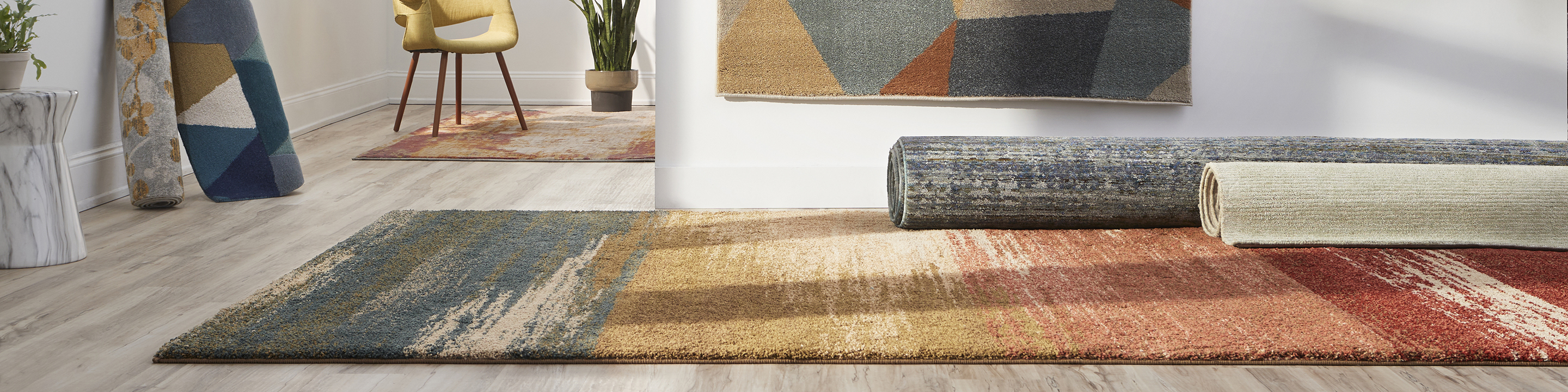
The single most important tool for anchoring a floating sectional is an area rug. A perfectly sized rug that fits all the legs of a sectional will create a visual boundary indicating where the “room within the room” is.
Size is vital. A rug that’s too small won’t fix your “floating” problem, as the entire arrangement feels adrift in the room. An L- or U-shaped sectional is typically 120–160 inches wide, so a 9' x 12' or 10' x 14' area rug should comfortably fit all legs. Don’t be afraid to size up your rug – it’s safer to go bigger and give yourself some extra breathing room.
An area rug also helps to physically anchor the sectional. If placed on hardwood floors without floor-friendly grips, sectionals can drift, and modular pieces can start to pull apart. Adding a rug adds the friction needed to hold the piece in place. Make sure to also add a quality rug pad to stop the rug from sliding on hard floors.
Add a Console or Sofa Table Behind the Sectional
A console or sofa table placed directly behind a sectional helps you in two ways: it defines the edge of the seating area and gives you a functional surface for decor, food, or drinks. This is especially convenient if you have walkable space behind the sectional – guests will have a finished vantage point rather than a view of the back of your sofa.
Filling in that space with a usable furniture piece makes the space feel intentional and a bit more tethered to the rest of the room.
Group Furniture Around the Sectional to Create a Zone
Additional seating shouldn’t be scattered around an open floor plan. Place accent chairs, an ottoman, or a loveseat close to the floating sectional – either with front legs on the area rug or just outside its edge. This will create a conversation area that is centered around the sectional as a focal point.
Use tables strategically to strengthen the layout. Side tables create a consistent visual perimeter while a coffee table directly in front of the sectional provides a convenient gathering spot for essentials like books, remotes, and serving trays.
Ideally, this area creates a defined space for relaxation and thoughtful conversation. In an especially large room, you can create two cozy conversation zones and unify them with matching lighting or a shared color palette.
Shop the look
Elmdale Table Lamp · Sonny La Torre I Wall Art S3 · Fluffton Area Rug · Tatum Cocktail Ottoman · Warner 5-pc. Leather Sectional · Oxer Coffee Table w/ Casters · Oxer End Table
Let Lighting Create a Natural Boundary
When placed against a wall, the wall itself creates a natural edge. Without it, lighting can fill in and create a perimeter. Strategically placed floor and table lamps can help you visually map the boundary of the seating area anchored by the sectional.
You can also place a pendant light or chandelier centered above the seating area to reinforce the boundary from above.
Consider a Modular Sectional for Extra Flexibility
With an expanded floor plan, you’ll benefit from furniture that can adapt, and modular sectionals do just that. Unlike a fixed sectional, modular pieces let you rearrange, add, or remove sections depending on your needs. This is especially useful when you aren’t working with a wall as an anchor.
You can maneuver the pieces to form an L- or U-shape depending on your layout, or split the sectional into two separate sofas. This type of flexibility is especially helpful if your original floating arrangement isn’t working and you need to adjust.
Learn more in our guide to modular furniture.
Common Mistakes to Avoid
There are some common but fixable mistakes to watch out for when placing a sectional without a wall behind it.
- Overcrowded walking paths: You can place complementary pieces around a floating sectional to create a conversation area, but you still don’t want to box it in. Ideally, leave 30 inches of clearance around the seating so people can comfortably move around. Even an open floor plan can feel walled off if the furniture is on top of each other and there aren’t clear pathways.
- Ignoring sightlines: Think about how the sectional will be viewed from other rooms or by people entering the space. It will likely be the focal point of your room, but you need to know how it will be visible. Walk the room from every entry point before finalizing placement. Once you have the sectional placed, then you can design around it.
- Mismatching furniture scale: If you’re filling an open floor plan with a large and deep sectional, you probably don’t want to pair it with small accent tables. It’s still important to maintain a level of cohesion, especially in terms of furniture scale. All pieces in a grouping should feel proportional and not out of place.
- Ignoring the back of your sectional: Even if you don’t want to place a console or sofa table behind your sectional, you can fill in that empty space with a plant or two, a short bookcase, a pair of outward-facing accent chairs, or even a bar cart. The goal is to make the sectional feel finished and not exposed.
Shop the look
Silla Table Lamp · Kazuma Area Rug · Montecito 4-pc. Sectional · Calibri Rectangular Cocktail Table · Calibri Rectangular Console Table
From Floating to Finished
Walls aren’t what make a sectional feel as if it belongs in your living room. Just make sure not to overlook the area around your sectional; it deserves just as much attention. If not, your open floor plan will feel like wasted space.
With the right rug and lighting, a console table filling the back, and furniture grouped with purpose, your sectional will feel grounded, intentional, and right at home.