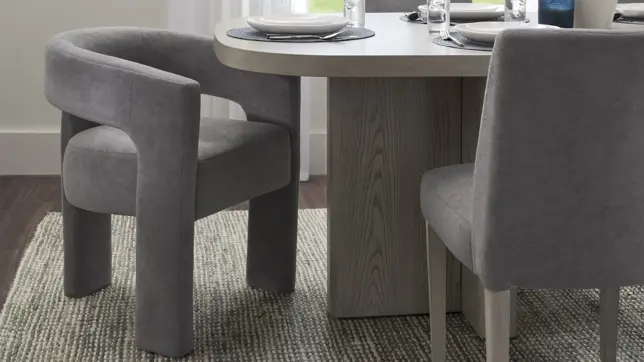
Curved furniture has a way of letting a room relax. A curved sectional draws people inward. An oval dining table makes it easy to see and converse with everyone around it. Some rounded pieces make a room easier to move through, particularly when a rounded edge replaces a corner that juts into a walkway. But that doesn’t mean filling a room with rounded pieces. Mixing organic shapes with clean lines is what gives you a look that’s collected and balanced.
Creating a Softer Space With Curved Furniture
Why are curves so engaging? Part of the appeal is visual. Most rooms are built around straight lines: walls meet at right angles, windows and doors create rectangles. When sofas, tables, and storage pieces with crisp edges are added, a space can feel rigid and visually busy. Introducing a fluid line breaks up the monotony. A rounded silhouette gives your eye something different and less abrupt to follow.
Then there’s functionality and practicality. When it eliminates a sharp corner, a rounded edge can make a pathway feel easier to maneuver through. (And, of course, bumping into a gentle curve is generally kinder on the body than meeting a sharp corner – a bonus for households with kids and pets.)
Finally, a connection with nature. The natural world is full of organic, irregular contours: rivers, hills, coastlines, pebbles, leaves. Bringing some of those softer forms indoors can make your surroundings feel more familiar and comfortable.
How to Make Curved Furniture Work for You
To make curved furniture work with what you already own and love, focus on creating contrasts. An interior filled almost entirely with rounded furniture can seem unfocused; it’s the duality of hard with soft that creates harmony.
Balance curves with straight lines
The easiest way to do that is to balance it with crisp, straight-edged pieces. A curved sofa and a rectangular rug work beautifully together. An oval coffee table can mellow a boxy sectional. A barrel accent chair adds movement to a room filled with sleek mid-century furnishings.
Give your furniture breathing room
A curved sofa can look especially striking when you can see its full silhouette, but that doesn’t mean it has to be placed in the middle of the room. In a larger area, floating it can help define a conversation area. In a tighter room, placing it closer to a wall may be the smarter use of space.
For smaller rooms, rounded chairs and tables, or just an oval or round mirror above an angular credenza can create a welcoming organic atmosphere. Even subtle changes will help shift the mood.
Echo the shape
Repeating a curvy shape once or twice elsewhere helps the room feel connected without making everything match. There are a few easy ways to do it:
You can get the same sense of cohesion with smaller touches, too. Think of it as layering: using curves of different scales to develop your curated look.
A curved sofa can be the easiest way to make a living room feel softer, but it’s also the piece that requires the most planning.
Unlike a traditional sofa, a curved sofa doesn’t always sit neatly against a wall, and that’s part of its appeal. In a larger space, a floating one can help define a conversation zone while simultaneously showing off the silhouette. In a smaller living room, positioning it away from the wall can take up valuable floor space and make the room feel tighter instead of softer. If your floor plan is compact, look for a curved sofa with a relatively shallow depth and a footprint that leaves comfortable pathways around it. Always measure the entire piece, not just its width, before you commit.
Give the curve a partner
A rounded coffee table is a natural pairing; it echoes the sofa’s shape and avoids introducing a sharp corner into the center of the room.
You don’t want to end up with a room full of circles. A rectangular rug, straight-lined media console, or angular side table can provide contrast.
Keep the styling relaxed
Pillows and throws can add softness without competing with the sofa’s profile. A few pillows in varied shapes, materials, or sizes can emphasize the relaxed feel. A casually draped throw adds another layer of texture and visual interest.
The sofa itself is already making a bold statement, so you don’t need to pile on extras.
How to Choose Other Curved Furniture Options
If you’re not ready to say yes to a curved sofa, you don’t have to. Consider dipping your toes into the trend with smaller pieces, such as living room tables, accent chairs, or accessories.
A round, oval, or even kidney-shaped coffee table or a curvaceous side table is one of the easiest ways to experiment with rounded pieces. These are relatively small but can make a noticeable difference in a room filled with angular furniture.
A curved accent chair, such as a barrel style, is another low-commitment option. Compact designs can easily pair with traditional rectangular sofas, and they can also make moving about a seating area feel more natural by eliminating hard corners.
Unlike a major piece that requires space, rounded accent tables and chairs can be easier to work into an existing layout or tuck into an unused corner. This is also a good way to test whether you actually like living with a less-structured look.
Don’t forget curved rugs
A curved rug can be another way to soften a room, particularly when the rest of the furniture is angular.
Round rugs work well beneath round dining tables, in conversation areas, under or beside a bed, or in an entryway. An oval rug offers the gentle look of a rounded shape with a little more length.
In a living room, though, don’t choose a round rug just because you have a crescent sofa. The rug still needs to be appropriately sized for the seating area.
If you love the idea of a round rug but need more coverage, consider an organic or irregular shape rather than a perfect circle.
What about a curved dining table?
Curved-edge dining tables can help soften a room filled with rectangular architecture while making the area feel more inviting.
Oval tables are elongated and can provide plenty of seating without overwhelming the space.
Round tables are an excellent choice for more intimate seating. Because everyone faces the center, dinner conversation is easier. The versatile shape works well in smaller dining rooms, kitchens and breakfast nooks. With no corners, round tables are smart for families with small children.
Pedestal tables – that is, a table supported by a single, centered pedestal instead of four legs – are another popular option for smaller spaces or apartments.
As with any dining table, measure before you buy. Check the actual dimensions and allow for the chairs you’ll use with it.
Curved furniture can be a great way to shift the vibe of a room, but it’s not automatically the right choice for every space. For instance:
It can take up more real estate. A deep curved sofa or chair may have a larger footprint than its straight-edged counterpart. Precise measuring is key.
It can be harder to arrange. A curvy sofa may not work against every wall, and its shape can limit where you place a coffee table, side tables, or other seating.
It can be less flexible. Rectangular sofas and tables tend to work with more room layouts. If you rearrange your furniture often, more conventional silhouettes may give you greater flexibility.
None of these are reasons to avoid curved furniture. Just make sure the piece fits your room instead of forcing your room to fit the piece.
Curved Furniture FAQs
Do curved sofas take up more space than regular sofas?
Curved sofas need a little more breathing room because they work best floated away from the wall, but many wrap-around designs seat as many or more people in the same footprint as a standard sofa.
Can a curved sofa go against a wall?
A curved sofa can sit against a wall, but its shape reads best floated in the room or angled into a corner where you can see the full arc. When propped against a wall, the curve mostly disappears.
Can curved furniture work in a small room?
Absolutely, but the footprint matters more than the curve. A common misconception about curved furniture is that rounded shapes automatically save space. They don’t. A deep, oversized curved sofa can take up considerably more room than a streamlined rectangular sofa.
What curves can do is make a compact room feel less dominated by hard edges and visually lighter. There are several ways to make them work:
Choose pieces with a smaller overall footprint.
Pay close attention to depth as well as width.
Use rounded tables where sharp corners would interfere with pathways.
Leave some breathing room around statement pieces.
Choose furniture with visible legs or open bases when possible to keep the room feeling lighter.
Don’t crowd a curved piece with other oversized furniture.
When you don’t have much room to work with, one well-chosen curved piece can have more impact than several smaller items competing for attention. Measure your space and introduce curves where they actually improve the layout.
What shape rug goes under a curved sofa?
A round or oval rug echoes a curved sofa’s lines and helps anchor it when it’s floating, though a large rectangular rug also works as long as the front legs sit on it.
Is curved furniture a passing trend?
Curved furniture is a mid-century revival rather than a new fad, so a well-made curved piece in a neutral fabric will still look current years from now.
A Softer Room Doesn’t Have To Be a Curvy Room
Curved furniture changes the visual rhythm of a room. Where straight lines and right angles can make a space feel structured or even stiff, rounded silhouettes bring visual quiet.
You don’t need to go all-in on curves to soften a space. Start with one piece you genuinely love. Echo its shape somewhere else, mix in some straight lines for contrast, and let the rest of the room follow naturally.
'/%3E%3C/svg%3E)